Sunday, March 12, 2023

Why Raghuram Rajan view about India going back to ‘Hindu’ rate of growth is problematic: Indian Express March 9, 2023

 https://indianexpress.com/article/opinion/columns/raghuram-rajan-india-hindu-rate-of-growth-problematic-8487111/


Saturday, March 4, 2023

The onion episode needs to be redressed: Free Press Journal 4th march 2023


In the west where futures markets are well developed and robust, farmers take a call on the crop by seeing the futures prices of various crops so that their basket widens. In this case they hedge against such instances of over production by crop diversification

The media has reported quite extensively that a farmer somewhere in Maharashtra got Rs 2 for a consignment of 512 kgs of onions sold in the mandi after all other charges were deducted. The price received was Rs 2 a kilo. We in Mumbai are paying anything between Rs 20-25 a kilo for onions and government data shows the range to be Rs 14 (Pune) to Rs 35 (Salem) across India. Kohima pays as much as Rs 45 a kilo (Feb end).

The same situation prevails for potato where farmers are getting a single digit price while consumers do not feel the glut like situation. This situation is not unusual in India. We have had situations when onion and potato prices have spiraled upwards of Rs 100 a kilo as well as seasons when tomatoes were dumped on the state highways by farmers in Maharashtra and Karnataka due to the absurd situation described earlier. What really is wrong in our system?

The issue is that the focus of policies have always been in giving handouts to farmers or talks on waiving of loans. It is supposed to work to gain favour. But there has been no permanent solution sought to be offered to farmers at large. When it comes to horticulture the challenge is that one cannot replicate the wheat and rice model where the government procures the same at a MSP and then stores the same until it is disbursed under the Public Distribution System (i.e. ration shops). In case of potatoes there is a case for enhancing the cold storage capacity as the crop typically has two seasons though is made available throughout the year. For onions, storage is a problem and the shelf life is much lower as it is susceptible to damage as it is not moisture resistant.

In this context, one can refer to the two farm laws which have been put in abeyance. The first is the one which talks of sale outside the mandi anywhere in the country. There is a pressing need to provide these options to farmers so that they are not at the mercy of the adathiyas (intermediaries) in the mandis. As the price paid by consumers is still much higher than what the farmers is receiving quite clearly there is a case for allowing farmers to sell directly to the consumers. This has to be facilitated by the state governments through the setting up of farmers markets periodically — maybe every Sunday. This is also where the government needs to subsidise the transport costs where farmers can pool their produce and bring to the cities.

This episode also shows the fallacy in opposing the farm laws, because they spoke of giving choice to farmers. In such a situation they would have preferred to sell it directly to the consumer.

The second relates to contract farming. Encouraging farmers to have buyback relations with corporates will help a lot to alleviate the pain. A large section of the food manufacturing industries ranging from readymade foods to ketchups make use of onions in their preparations. Forging such contract farming relations will help the farmers a lot. In fact, there is a big export market for such processed foods which can bring about an end-to-end solution.

Going beyond the farm laws, there are two things which need to be done immediately. First there has to be an intelligence system which guides farmers on what to produce. What we are seeing in the case of onions is the famous ‘cobweb syndrome’. Farmers decide on their crop based on the prices received in the previous year. As onion prices were very good in 2022, there was a tendency to grow more of the crop. Now as farmers grow more, supplies increase manifold leading to surpluses and consequently prices crash thus creating this ugly situation.

In the west where futures markets are well developed and robust, farmers take a call on the crop by seeing the futures prices of various crops so that their basket widens. In this case they hedge against such instances of over production by crop diversification. Onion is however a difficult product to have futures given that it is a perishable. Here the government should conduct programmes to educate them on diversification. For this to happen there needs to be a good market intelligence system for such ideas to be conveyed to the farmers. This has to be an ongoing process and the panchayats have to be involved in spreading this information.

The other is the development of cooperatives. The milk story in India pioneered by AMUL is legendary. The product is probably the most perishable one which needs to be collected, stored, and marketed on an on-going basis in a manner to ensure there is minimum wastage. At the same time there is an assured income to the farmers and there is a great deal of balancing done on the management of supplies. Surpluses are converted to value added products which have a longer shelf life. The same needs to be considered and developed for crops like onions.

There is pressing need to address the concerns of farmers dealing with onions, potatoes and tomatoes as there have been several episodes of extreme volatility in production and prices. On every occasion, nothing much is done. When there is a shortage, there is chaos and imports are reckoned as the blame game continues and consumers pay high price. High supplies on the other hand have never been addressed. This is so because no attempts have been made as it is assumed that everyone forgets the issue after a couple of months and life carries on. Besides the distress caused to farmers who would also witness their indebtedness increase. In the past a combination of negative returns and indebtedness has led to farmer suicides. We need to address these issues with urgency before we talk of becoming a $ 5 trillion or $ 7 trillion economy.

Madan Sabnavis is Chief Economist, Bank of Baroda, and author of ‘Lockdown or economic destruction?’ Views are personal

Tuesday, February 28, 2023

Low GDP estimates on expected lines, but manufacturing remains a cause of concern: 28th February 2023

 The GDP numbers released today for the third quarter (Q3) of the year and the revised estimates for FY23 (financial year 2023) have by and large been on expected lines. For the year, the NSO has stuck to 7 per cent, which means there is no change from the preliminary estimate made earlier. For the third quarter, growth is at 4.4 per cent, as projected by the RBI. (The Bank of Baroda estimate was 4.6 per cent).

Growth in Q3 has been driven mainly by the services sector. First, the component including trade, hotels, transport etc. has grown by 9.7 per cent on top of 9.2 per cent last year. This is due to pent-up demand in the segment once the sector was fully opened up from April 2022 onwards, which is also reflected in the PMI numbers. The third quarter coincides with the post-harvest and festival season, which supported this growth. Higher GST collections also supported this growth.

Second, the financial and real estate component grew by 5.8 per cent, which could have been higher in case households had saved more in bank deposits. Yet, growth here has been higher than last year. These two trends have countered the slowdown in growth in the public administration, defence and other services segment which grew by just 2 per cent as the government was cautious in its revenue expenditure. In fact, the growth in GVA was 4.6 per cent while that in GDP was lower at 4.4 per cent as the net taxes (taxes minus subsidies) were negative since the subsidy bill rose due to higher allocations for food and fertilisers.

A setback was expected is the manufacturing sector. But -1.1 per cent is lower than expectations. This can be attributed to depressed profit and loss accounts of companies, as profits had come down due to higher input costs which came in the way of value addition in this sector. This year, the growth is likely to be just 0.6 per cent. This has been the Achilles heel of our growth story. Jobs will be created only if this sector grows at a robust pace on a sustained basis. Sluggish growth in consumption has come in the way as seen by negative to low growth in the consumer goods segment all through the year.

Construction has been a saviour in this scenario with growth of 8.4 per cent due to the smart demand for housing that has been backed by bank credit too. Also, the government push on infra, especially roads, has helped to hasten the pace of growth. Agriculture has added to the growth though there are concerns about the rabi crop given the heat wave. For the year, the NSO is looking at 3.3 per cent growth, which can slip if the wheat crop is affected, as it happened last year.

During this quarter, there has been a decline in the share of consumption in GDP from 65.1 per cent to 63.3 per cent. Higher inflation too has come in the way of growth in consumption as incomes have not been increasing in a commensurate manner. Also, the gross fixed capital formation rate has increased only marginally from 26.6 per cent to 26.8 per cent. While the government has been doing its bit on investment by spending where required, the private sector has been slow to match the same for the last 3-4 years. This is reflected in the data on capital formation. Ideally, it should have increased at a faster rate. This is also seen in the pattern of growth in bank credit, where retail — rather than the corporate segment — has been the driver.

The RBI can take heart at these numbers as they are on expected lines. It can continue to look more closely at inflation, which the MPC is expected to target. The present heat wave is disturbing from the inflation perspective. It has the potential to keep the CPI inflation in the region above 6 per cent for a longer period of time if the wheat crop registers a decline in production. The RBI, however, need not revisit the GDP growth forecasts it had for FY24 — which was at 6.4 per cent — as the figures for FY23 have not really changed. The government and the Union budget too would take heart from this number for FY23 as no further alterations have to be made on the assumptions made when working on the fiscal arithmetic for FY24.

How global is India’s economy? Businesslike 1st March 2023

 There is now a consensus on India emerging as the second fastest growing economy for the second successive year in FY24, despite the slowdown in the West.

Does this mean that India’s growth path is largely decoupled from the rest of the world?

When the ‘Make in India’ campaign was launched, its objective was to foster export promotion. Import substitution, too, was an implicit goal. Now the PLI scheme gives outright subsidies to around 14 sectors for making a certain quantum of investment that is linked with incremental output that would finally be rewarded with a 4-6 per cent payback. This has also been a means for both import substitution and exports promotion.

The question that arises is that if we have made progress on exports, then there should be some adverse impact on growth when a part of the developed world slips into a recession. Besides, in a globalised world, there could be spillover effects in other areas, especially in foreign investment flows through both the direct and portfolio routes, which would slow down.

Further, a recession in the West would also mean that demand for Indian labour as well as computer related services would come down. These could affect our balance of payments. At the other end, ECBs and NRI deposits too will get impacted depending on the policy of interest rates, especially in the West. Rising rates in the US would make ECBs dearer and NRI deposits more attractive in local territory, which will have a negative impact on domestic funding flows.

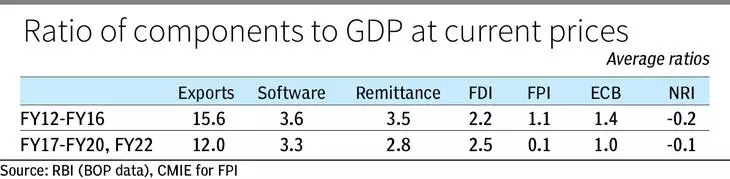
The table juxtaposes all these elements with GDP at current prices. The purpose is to see how these components have moved along with GDP in the last decade. As a component of GDP, exports boost growth, the other flows are assumed to increase as a proportion of the GDP. Normally, absolute figures of software receipts and remittances, when viewed in isolation of the GDP, do not give a true idea of how they are faring over time.

Data for the last 10 years have been considered here and the average for the last two quinquennium has been considered. The second quinquennium excludes 2020-21 and hence includes FY17-20 and FY22. The first period covers FY12-FY16.

Several interesting points emerge from this table. First, the ratio of exports to GDP has come down over time. This is both good and bad news. The good part of this story is that it shows growth is primarily driven by domestic factors and hence decline in exports does not affect GDP growth significantly. This is probably one reason why growth projections are high for next year, at 6-6.5 per cent. The not-so-good part of this story is that even though a lot of push has been given to exports with specific emphasis on sectors that have a comparative advantage, they have not quite managed to carve a niche.

Even where opportunities have arisen, such as the US putting restrictions on Chinese imports or the more recent the Ukraine war, we have not quite made any significant inroads. Hence this means that while a steady growth in exports will supplement domestic growth, we are far from being an export-led economy.

Second, while software receipts growth in rupee terms has been 56 per cent in the last five years, the GDP it has lagged and hence in relative terms has not kept pace. Quite clearly this will be an area of concern in FY24 if the recession hits the demand for these services.

Third, the fall in the ratio for remittances is also considerable, as it has declined from 3.5 per cent to 2.8 per cent. Here too growth has been just 35 per cent in rupee terms for the average remittances in the two quinquennium. The pace of growth has not been in line with the GDP growth even though it has been rising. Here too there can be an impact at the margin due to the global slowdown.

Fourth, the FDI flows have been very positive with growth of 89 per cent in rupee terms in the last five years. This is an area where there is uncertainty. The flow of FDI depends on both push and pull factors. The pull factor is strong with the economy doing well and the policy framework in place. In fact, the China factor will shift more investments towards India. However, the push factor will depend on both the quantum of investible funds available. Therefore the net impact needs to be monitored closely.

Fifth, the ratio of FPI to GDP has come down sharply due to the negative flows witnessed in three of the five years. In a way this should provide comfort; even if these flows are minimal, they will not affect our markets as the indices have ballooned notwithstanding these negative flows. Domestic institutions have provided an insulation to a large extent.

Interestingly, the net NRI deposits have been negative on an average basis in both the periods. This means that there is no reason to be dependent on them for support from the point of view of balance of payments. ECBs too have seen a decline from 1.4 per cent to 1 per cent and would not be attractive at a time when the interest rates are rising all over.

What this data shows is that India still remains a largely domestic economy which provides strength to growth. But a recession does have implications for the external sector where inflows can get dented at the margin. Cumulatively they have the potential to pressurise the rupee which will remain a variable to be monitored closely by the RBI.

CEO salaries as a multiple of median pay vary widely : MInt 1st March 2023


CEO compensation has always been impressive in the private corporate sector. In the last two decades or so, there has been a substantial change in how these packages are looked at, with the inclusion of stock options. It is normally believed that once a company’s top management or employees are awarded stocks, they have an incentive to work harder to enhance shareholder value because as profits increase, so does the firm’s market valuation, which in turn benefits everyone. This largely holds in the private sector, though the public sector too runs employee stock option schemes at times. But what about non-stock based compensation?

One may recollect that in the past, a prime minister had spoken about high executive compensation and the need for moderation. That was a subjective view, as, in a capitalist system, the market decides compensation. And normally, as the top management witnesses an increase in pay packages, those down the line also benefit, though not to the same extent. It is the old theory of trickle- down effects.

At the end of the day, any top-level pay package must be ratified by shareholders in an annual general meeting, which is often the clinching argument. If shareholders are okay with a big package, nothing is amiss because it is a reward for performance. The CEO takes maximum responsibility and is answerable to the board, which guards the interest of shareholders. Therefore, any debate on this issue is only academic. The Reserve Bank of India (RBI) has a structure for permissible executive pay at banks, where certain personnel also run the risk of a claw-back in case things go terribly wrong. But in sectors with no such rule, the market decides on the CEO’s pay package.

Average employee compensation varies across industries. Typically, companies which are more knowledge-based tend to have higher rewards, compared to those where skill levels are lower. These days, it is mandatory for companies to reveal the ratio of CEO compensation to the median pay of their staff. This is an interesting metric because it shows how much the CEO is valued. There is, however, no norm for this ratio. There was a time when one could talk of the ratio of the highest and lowest paid worker. But this won’t make sense in manufacturing concerns or even services, where there could be a large number of unskilled workers. Hence, while the median is not the best metric, it is still acceptable when talking of how these heads are valued by their companies.

There is data for 2021-22 on the remuneration multiples of the top person (executive chairman, CEO or MD) to the firm’s median salary for BSE-30 companies. Public sector companies do not need to publish this information, which would anyway be embarrassingly modest. This leaves 27 companies, of which three did not report the same. As far as possible, stock options which have vested have been excluded. We see that the BSE-30 multiples vary from as low as 31 (Maruti Suzuki) to a high of 670 (Larsen & Toubro), which is quite a wide range. TCS’s ratio is 396. Importantly, no specific pay proclivity can be seen in any sector and there are spikes in both the manufacturing and financial sectors, depending on the company.

The multiple shows how a company values its top business leader. These multiples can however be skewed, depending on the median salary of the staff. Not all 30 companies have provided this information, but some have. In the case of Tech Mahindra, for example, the median annual salary in 2021-22 was 5.27 lakh. Hence its multiple of 87 would not translate to a very large compensation in relative terms. In L&T’s case, the multiple of 670 goes along with a median salary which is higher at 9.14 lakh for the year. A company’s median salary tends to vary by the extent to which it has unskilled labour employed, for which the remuneration would be much lower.

The ratio in the financial sector is interesting. These firms too have the characteristic of having a large workforce in sales, which would be on lower pay scales. Here, the variation is quite significant. Kotak and Axis are at the lower end, with multiples of less than 100, while HDFC and IndusInd are much higher, with ICICI Bank somewhere in between. The ratio for Bajaj Finance, a non-bank financial company, is 246, which can be compared with HDFC Ltd’s 156.

Clearly, the person on top is valued many times more than the average employee across the board. This can be linked with the job’s disproportionate responsibility. Often, there could be another 5-6 personnel earning slightly lower than the CEO but significantly higher than the median. Most of these remuneration packages come along with stock options, as also guaranteed pay increases. There would also be a big variable component that is linked to the financial performance of the company.

A provocative thought comes to mind here. In the present context, several companies both globally and within (especially in the IT and fintech spaces), are going in for mass layoffs. There are never instances of CEOs being removed to save on costs, considering that their pay packages can be 300-400 times the median, which means it would be the payroll-cost equivalent to that number of employees asked to leave. While the CEO takes most credit for success, the chief faces no downside when the chips are down. Heads I win, tails you lose? This should foment some debate.


Sunday, February 19, 2023

It is impossible to escape globalisation: Free Press Journal 18th February 2023


Can we ever be free from global waves? Even today at the macro level the smell of a recession in the West has already caused considerable turbulence in economic forecasts, and this is where India stands out by being decoupled. But at the micro level, globalisation still stands strong as is seen in India recently

The trend these days is for countries to become more inward looking. Besides politics which appeals to the electorate, Covid has justified such jingoism. But can we ever be free from global waves? Even today at the macro level the smell of a recession in the West has already caused considerable turbulence in economic forecasts, and this is where India stands out by being decoupled. But at the micro level, globalisation still stands strong as is seen in India recently.

The controversy relating to a large Indian conglomerate bears testimony to this theory. The case is simple. A short seller in the USA had a report on the conglomerate where certain failings were alleged and this came out at a time when the Indian group was going in for an FPO. A micro issue should ideally not have become a macro one. But it did, at least temporarily.

The impact on the landscape has however been far-reaching, as several questions have been raised as a consequence of this episode. The RBI has acted with alacrity and done a quick reality check with banks. The press release put out that the banking system remains as strong as ever is timely and keeps out speculation. The exposures of the system to the group are low and well within the limits prescribed by the regulator even in case the worst-case scenario plays out. This is assuring.

SEBI would also be looking into the allegations made as they are in the realm of market practices. The issue is complex as the Mauritius route has always been known for opacity and would require time to get things clarified.

Let us see now as to how the process of globalisation has led to seepage through the domestic system, raising several doubts. First, to begin with the news of the report had an impact on the prospects of the IPO which remained unsubscribed by the retail investors and it was a last minute entry of certain players that saved the issuance. This was probably expected.

Second, along with this news, the share prices of the group companies went down, which has been magnified as being the loss to shareholders. This should be read with caution because there is a difference between notional and actual loss. The notional loss, as the word indicates, is only theoretical. The actual loss is only when a sale is reckoned. Typically investors don’t sell when there is bad news; but the erosion in market cap was sensational. The market is now back to normal after a fortnight treating this episode more as ‘noise’ which can be ignored now.

Third, as long as the controversy lasts, foreign investors will think twice about these stocks, which is not good news. This is the collateral effect. Add to this the fact that some of the global indices have lowered the weight of these stocks, means that there is a second round of loss of interest in this Group’s shares. This is more a micro issue but is unsettling as we talk of Indian bonds being included in global bond indices.

Fourth, it is still not very clear whether foreign investors will lower exposures to India and choose other markets as ours is still enticing. A clarification on the governance issue will help here. FPIs have been negative in equities so far this month though it is hard to conjecture if the two can be linked. This is why a voice from the regulator would help to assuage sentiment here.

Fifth, while the RBI has put out the green flag, lending institutions will review their options on further lending. Overall leverage of this group and other such conglomerates will be looked at more closely by the banking system. This will be more of a hygiene issue at the micro level as there is more scrutiny on other group lending too. Also, this incident will strengthen the case for not giving banking licenses to corporate houses.

Sixth, as most of these exposures of the system to the Group are in the infrastructure space, a question raised is whether there will be any pushback here in terms of private investment. This particular group has been a frontrunner in ports, airports, power, and storage among others and has in a way been instrumental for substantial building of infra in the country. For the last few years the government has been doing the heavy lifting on infrastructure hoping to crowd in private investment. The broader issue here is whether these contracts will be reviewed by the concerned parties. As of now it looks like that there aren’t concerns, but one can never tell.

Seventh, it is likely that there would be a deep dive investigation of several companies, especially those which have investors coming in from tax havens. This is a fallout of this episode for sure as there has been considerable opacity on this score.

Globalisation is hence still strong today with a single external report causing considerable disruption in the Indian markets (even if the political noise is ignored). There will definitely be learnings from this episode. A lot of cleaning up, which means revisiting both the banking as well as securities market, is likely to follow to ensure that there is more transparency in the system. But on the whole after the initial hiccups, business will continue as usual given the strength of the economy and the policy framework that is in place.


Age is just a number: Financial Express: 19th February 2023


Age is just a number

Life can be lived to the fullest at any stage

Age is just a number
The incidents penciled by the author are very personal and involve her family members and will resonate with her friends, but would be of no interest to the lay reader.

Insatiable: My hunger for life
Shobhaa De
Harper Collins
283 pages, Rs 699

The author goes to a book store and sees a man fretting over not finding a book on the shelf. When asked, the reply is that he is searching for the book he has written. He adds that he is not Shobhaa De whose books are always on the front display. This is very pertinent when it comes to the book Insatiable by De. It is a collection of thoughts post-covid and quite different from her earlier publications and not really meant to excite. Written like a diary, it is quite unpretentious, but interestingly finds a publisher, which others would find difficult, as it is penned by a celebrity.

The incidents penciled by the author are very personal and involve her family members and will resonate with her friends, but would be of no interest to the lay reader. She retains her wit and forthrightness while writing, which is vintage De. She continues to be droll as she writes about her Maharashtrian background and describes the values which some people of the community will give an affirmative nod to. She also takes her shot at the Shiv Sena when she has to choose a menu for visitors and does not want to get into trouble, like she did with the vada-pav controversy. And she adds tongue in cheek that our PM would agree with Bagehot, who said that to be an effective symbol one needs to be seen all the time.

One can get a peep into how high society lives in this narrative- the parties, travel, glamour and glitz. Life begins in what we call SoBo (south Bombay or Mumbai) and ends at the Worli-Bandra sea link for such celebrities.

There is nonetheless a certain zest in her life which is revealed through the book, with the takeaway that age does not come in the way of living life to the fullest, both in terms of appearance and attitude, which should be an inspiration for even grandmothers. That is ‘hunger for life’. She shows that at any age one can have the best of champagne and wine and still keep fasts and be religious and believe in horoscopes. She does exhibit signs of melancholy at the thought of aging and her knees going weak, but that’s fleeting.

There are some throwbacks to the past and people like MF Hussain, Aamir Khan and Salman Rushdie, with a bit of old gossip being shared by the author, like sharing a table with Rushdie with Padma Lakshmi. But it’s too little and far between, which can be a disappointment for readers.

Insatiable can be likened to probably the Karan Johar show on TV where one enters a world that is unreal to most of the audience. It is engaging to begin with, but gets mundane subsequently. But then diaries are personal and are not meant to excite.