Sunday, July 4, 2021

Book Review — How to Make the World Add Up: Ten Rules for Thinking Differently About Numbers by Tim Harford: Financial Express 4th July 2021

The months since the pandemic began have been a puzzle when interpreting various data on Covid, be it tests, infections, deaths, vaccine efficacy and side effects and so on. Media reports spin a new story everyday, which often evokes the fear element. That is the problem with data and interpretation. Mood swings can be driven by how we see such data that generally works on the negativity instinct. Therefore, you need to “step back and enjoy the view”. This is one of the 10 rules put forward by Tim Harford in another entertaining book on how to look at data or the caution to be exercised when interpreting it.

Presentation of data is not just tricky but also dangerous in some countries, as Harford shows us. In Tanzania criticising official data is a criminal offence. Graciela Bevacqua of Argentina was asked to show low inflation in 2007 and non-compliance meant getting the sack. In 2010 Andreas Georgiou of Greece was forced to show a lower fiscal deficit and when he came up with a number of 15.4%, he was removed from the statistics department. Another principle of Harford here is that “don’t take statistical bedrock for granted”. We in India will feel closer to this rule as all the data on employment, revision in methodology of calculating GDP and so on has ignited similar debate.

The problem with statistics is that it can prove anything. Early on it was found that countries that had high population also had large number of storks and hence the two were linked with causality. Then this was dismissed as being nonsense. The same negative argument was used to say that merely because a large number of smokers were detected with cancer, it did not prove anything. The tobacco lobby now had a strong argument on their side!

It is with these stories and examples that Harford takes us through the pitfalls of drawing conclusions based on data. At times we feel emotionally strong toward something and are plagued by the ‘ostrich effect’. Can one think of the most common example? Yes, it is the stock market. When markets boom, we refuse to believe that there is anything amiss in Covid times and find some rationalisation for the new highs, as experts tell us things will get even better. It is hence quite weird that an entire market can be interpreted in this manner as we are seeing today, to the extent that everyone believes these movements and it becomes self-fulfilling.

Often, we have surveys or experiments that are carried out and then generalised, and this holds for several trials of medical or even electronic products. Or for that matter even unemployment surveys, which are sample-based and then blown up to explain the universe. As evidently the samples cannot be more than half per cent of the population, we need to ask the question “what if someone is left out from this exercise”. This, according to the author, is important as often it is the entire female population that could be left out from the survey or experiment, which is normally the case with any such trials. The same can hold for children or the differently-abled and responses tend to be skewed. While we need not reject the findings, they may not be taken at face value.

Another rule that Harford puts across is: misinformation can be beautiful. This we can see when we look at company or government presentations when charts are shown in a selective manner and worded carefully to show facts without disclosing the truth. Using the right scales and pictures and focusing on a few achievements, the message conveyed can be very different from the true state of the country or company.

Even computers and algorithms can be misleading and there have been cases in the USA where they have supposedly scored over clinical research in terms of predicting the spread of influenza. By using Google to track the number of hits which search for pharmacies or information on the flu, programmes have been able to predict the spread of disease in specific locations. Fascinating as it may sound, these algos have limitation in the sense of not being able to read the mind through such tracking. Hence there have also been instances of false reporting, as a search may be out of curiosity rather than being afflicted by the disease, as has been the case with the Covid pandemic.

At a personal level he warns us to keep an open mind and not be dogmatic on our views on data movements. Here he gives the example of the genius economist, Irving Fisher, who made a lot of money predicting future events but refused to change his view as the Depression set in and lost his entire wealth and became a big debtor! This was the result of being dogmatic in views.

It is true that we live in a world where there is a plethora of data that is being thrown at us to show that things are really great. The language and data point to show that the Indian economy is recovering from the pandemic is not very different from what we saw in the USA before the presidential elections. This is where Harford’s 10 rules can help us sieve the cloud of noise and see the true picture.

That’s why he ends the book by saying that we have to constantly remain curious because often “we think we know which we don’t” and this frailty is used by the purveyor of information to drive home the messages that may not be right.

How to Make the World Add Up: Ten Rules for Thinking Differently About Numbers
Tim Harford
Hachette
Pp 338, Rs 699

Thursday, July 1, 2021

The economics of loan guarantees; Financial Express 2nd July 2021


The economics of loan guarantees

By:  | 
July 02, 2021 5:00 AM

The Centre’s credit guarantee scheme pushes down the interest rates on savings as also PSBs’ interest income

Now, guarantees have been going out of fashion in line with FRBM, and states are being told to lower these when supporting state PSUs.Now, guarantees have been going out of fashion in line with FRBM, and states are being told to lower these when supporting state PSUs.

The concept of credit guarantee by the government, on loans given by commercial banks, is as close as it can get for a link to be established between the sovereign and private borrower. As borrowers tend to be small—SMEs or tourist guides or MFIs—it is a unique way of supporting flow of funds. This has been actively followed by the government as part of Covid relief, and opens the doors for more such inclusions as these are blanket guarantees.

How does the economics of this look? The government spends nothing on such loans as it is a contingent liability. The Centre offered Rs 3 lakh crore last year and another Rs 2.6 lakh crore this year (total Rs 5.6 lakh crore). As of FY20, the latest for which data is available, total outstanding guarantees of the Centre were Rs 4.7 lakh crore, with incremental guarantees being Rs 20,000 crore. This was before Covid. Now the amount will be more than double. Outstanding debt as of FY22 would be Rs 136 lakh crore, which means that these new guarantees will be around 4% of total. But this will be a fiscally neutral position and will have an impact only if there are defaults and the government has to step in.Now, guarantees have been going out of fashion in line with FRBM, and states are being told to lower these when supporting state PSUs. This is why we had the UDAY scheme for discoms where states were asked to transfer such debt on to their books rather than shield through this curtain. The pandemic has led to a U-turn when it comes to off-balance-sheet items. The Centre had, in the FY22 Budget, sought to get more transparent with FCI transfers by including the amount in the Budget. But, these unusual circumstances have justified such an action. The government, however, needs to put in place a rule on guarantees so that they don’t become a habit.

The other important thing about guarantees is that there is a cost involved on the commercial side. The government has fixed the ceiling interest rate on all these loans, which can range from 7.95% to 9.25% (SMEs). This is below the market rate that can be 4-5% higher for MSMEs. This is good for the borrower, but what about the bank? If Rs 5.6 lakh crore is being disbursed at a rate of 5% lower than normal rate, the loss of income for banks would be around Rs 28,000 crore. This is one of the reasons why banks continue to pay lower interest rates on deposits as there are too many compulsions imposed as part of the government’s social/welfare policy.

Ideally, this should have been done as an interest rate subvention, which is the case with farm loans. But, here, it appears the government saves Rs 28,000 crore on the revenue account, which gets reflected in lower interest income for banks for a period of at least three years until the amount is repaid. This is a big burden to PSBs which are just about getting up.

What about repayments? Most of these loans have/are being given for three years (plus moratorium), which means that the quality of the asset will be standard until such time they come for final repayment. It will be interesting to see how the mechanism works because, with an average NPA ratio of 10% in this segment in the past, there could be progressive claims from the government on interest and principal payment. The fact is that if a tourist operator or an MSME is unable to operate, there is no wherewithal to support repayment schedules.

The missing link is the appetite for funds and the willingness to lend. Banks will still cherrypick customers, while borrowers won’t overleverage merely because there are cheaper funds with a guarantee. The economy has to turn first before this becomes attractive. Loan guarantees, on their own, may not be able to provide momentum for this growth.

Did assembly polls fuel the spread of the pandemic? Free Press Journal 2nd July 2021

 There were elections held in four states and a Union Territory while in Uttar Pradesh, panchayat polls were held in the same period. At that point, none of the parties cared much about safety and rallies were held, as they would have been in pre-Covid years. However, once the results were out, there was a battle cry for lockdowns. Such schizophrenic behaviour is not unusual in India

Did assembly polls fuel the spread of the pandemic? Madan Sabnavis explains how such was the case

When the assembly elections were held in April it did appear quite ludicrous, as rallies led to people flouting social distancing norms. There were elections in four states and a Union Territory while in Uttar Pradesh, panchayat polls were held in the same period. At that point, none of the political parties cared much about safety and rallies were held, as would have been the case in pre-Covid years. However, once the results were out and the new governments were in place, there was a battle cry for lockdowns and people were not allowed to move out. Such schizophrenic behaviour is not unusual in India.

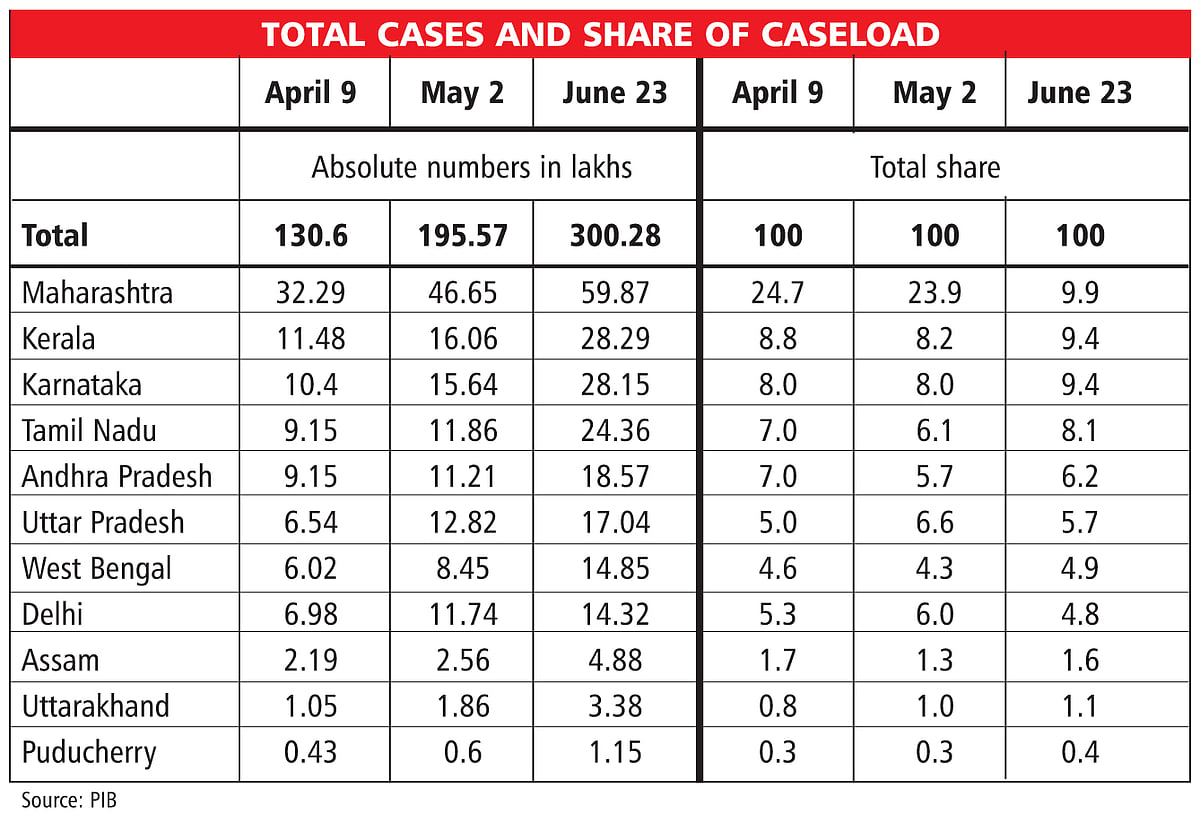
This was also the time when the Kumbh Mela was in progress in Uttarakhand. When the rallies were on, politicians argued that the virus would not spread because of such gatherings, as Maharashtra and Karnataka were two states which had the highest caseloads, despite not having held any election rallies. As over nine weeks have passed since the results were announced, it would be interesting to see how the caseload has moved over time.

Timeline of cases


Three points of time have been chosen – April 9, May 2 and June 23. Some interesting facts follow from the data on aggregate caseloads. Maharashtra has the highest caseload, accounting for nearly 25 per cent of the total of 130 lakh cases in April. By June, the total number of cases increased to 300 lakh but Maharashtra’s share came down to 20 per cent.

The same was seen for Uttarakhand too, with the number of infections increasing and the share going up at a gentle pace. Karnataka and Andhra Pradesh had also witnessed an increased share as the second wave was quite widespread. But Gujarat, MP and Bihar witnessed a decline in share in the post-May period.

The exception was Maharashtra, where the share came down in both the periods. But then it could be argued that the virus originated in this state and then spread to the others and hence the damage was done in April itself. In the case of Uttar Pradesh and Delhi, April was an unfavourable month, but post-May, there was a decline in their respective shares. In fact, post-May 2, the three southern states had a share of almost 12 per cent each in incremental infections, just lower than that of Maharashtra, which was at 12.6 per cent.

Infections up in poll-bound states

Hence, infections increased in election states, though some non-election states also witnessed such setbacks. If growth rates are reckoned over May 2, then poll-bound states and Union Territory fare badly, with Tamil Nadu, Puducherry and Assam, all having above 90 per cent increase. Uttarakhand, West Bengal and Kerala witnessed growth of 75-80 per cent while it was less than 30 per cent for Delhi and Maharashtra and slightly higher than 30 per cent for UP.

The other interesting thing about state performance can be gauged by the death rate. This is quite disturbing, as the average for the country is 1.3 per cent, but states like Maharashtra and Uttarakhand have a ratio of 2.1 per cent. The highest is logged by Punjab with 2.7 per cent, even though the total number of cases was relatively lower, at 5.93 lakhs. This reflects both the severity of the disease as well as the state health structures.

Robust health systems

In this context, Kerala has done extremely well, as with the second highest caseload, the death rate was just 0.4 per cent, which redounds to the credit of the health system. The states of Andhra Pradesh, Telangana, Rajasthan and Odisha have all registered death rates of less than 1 per cent. Once again, Andhra Pradesh had a high caseload but managed to control deaths, which is creditable. Tamil Nadu, West Bengal and Karnataka have a death rate of 1.2-1.3 per cent while that for Delhi is high, at 1.7 per cent.

To conclude, it could be said that the elections did cause an increase in caseloads even while some non-elections states also witnessed an increase. Some states, especially in the south, have robust health systems, which helped mitigate the impact of the pandemic as revealed by the lower death rates.

RBI's Financial Stability Report: A bag of surprises: Busienss Standard 1st July 2021

 Reserve Bank of India's Financial Stability Report is an eagerly awaited report to gauge the health of the banking system in particular and the likely stress situation. The readings from the report are encouraging just like the downward movement of the Covid curve in the country. Contrary to all expectations of NPAs increasing due to the pandemic, the report reveals that they were pretty much under control at 7.5% in March 2021. This should come as a relief to the market as earlier conjectures were in the region of 12-15%.

The other encouraging revelation is that the stress tests indicate that under normal conditions the NPA ratio will increase to 9.8% by March 2022 while the two stress scenarios could push it to 10.4% and 11.2%, respectively. But the stress scenarios look very unlikely as they involve GDP growth slumping to 6.5% or less than 1%. Therefore, one can be confident of the quality of assets being firm even though a flag has been raised by the on the migration in SMA quality. Significantly, in terms of restructured assets, the ratio is just 0.9%, which is low and surprising. Surprising because it was felt that the one-time restructuring exercise that was adopted would have led to several companies exercising this option, which is not the case.

Credit should go to the and for managing the situation. The plan of giving moratorium during tough times and rolling back the same has helped to keep things under check. The same holds for classification of NPAs where we are back to normal. too have not gone overboard in lending despite all the schemes, which has actually made NPA ratios in all sectors, except retail, to decline. The slippage ratio which is NPAs on incremental loans is low at 2.5% which gives credit to the  Similarly, the coverage ratio at 68.9% has also ensured that banks were progressive here, which has maintained sanity against any future shocks. In a way it can be said to be a true team effort in containing the situation. The lessons of the past has definitely helped banks to be more cautious.

The sectors of concern for NPAs- CGEM (construction, gems and jewelry, engineering and mining) have over 15% ratio while metals, infra, power, textiles, food etc. are in double digits. Chemicals and auto have done well with 5-7% range. Retail is minor concern even though the ratio is low at 2.1% as it should not become a part of the ‘culture’ of not repaying. Hopefully, this is temporary as last year was tough for individuals who were out of jobs and income to service their debt.

An interesting aspect pointed out in the report is that the has actually ensured that the investment valuation did not cause disruption for banks. Normally when there are large investments made in a market where the government borrowed Rs 12.8 trillion, yields should have gone up thus pushing prices down. However, by carefully managing the yield curve with various operations like GSAP and OMOs, banks have been protected against a valuation decline. This is also indicative of the fact that in 2021-22, the picture will be replicated as the yields have been kept down, which means that banks can be comfortable with the investment portfolio.

Last, even the profit ratios look good with NIM at 3.3% and return on assets too in the positive territory. One thing that stands out is that the cost of funds was 4.7% while yield on assets was 7.6% - quite clearly the deposit holder bore the brunt as 2.9% spread looks high by any standard.

Wednesday, June 30, 2021

Interview on Economic Reforms with Moneycontrol: 1st July 2021


30 years of economic reforms | Bottom 10% of population still do not live a dignified life: Senior economist Madan Sabnavis

Three decades of economic reforms have ushered in a major transformation in the size and quality of the economy, said Madan Sabnavis, Chief Economist of CARE rating agency, in an interview with Moneycontrol on July 1.

While reforms have put the economy on the fast track and made it comparable to the world's developed countries in terms of quality, the trickle-down effects have worked in a limited manner, Sabnavis said.

"The poor have become less poor; the rich have become much richer with inequality getting exacerbated. Further, those at the bottom 10 percent of the population still lack dignified living and it is more people in the middle and higher levels on the low-income scale, who have moved up," Sabnavis said.

"This, unfortunately, is the result of market economics or economic Darwinism. The governments have worked to give freebies but not been able to provide a sustainable living for them," he added. Edited excerpts:

Q: How do you assess the change in the Indian economy in the last 30 years of economic reforms?

A: The 30 years of reforms has ushered in a major transformation in the size and quality of the economy, which is more than admirable. Considering that the phase before reforms was typified by scarcity, control, absence of variety, a repressed financial system and absence of competition both in domestic and global market, reforms have put the economy on the fast track and made it comparable to the developed countries in terms of quality.

Q: How have economic reforms touched individual lives?

A: Growth has been swifter and there has been an increase in per capita income. We have moved in the use of technology in almost every field and the economy is characterized by surpluses everywhere. The final tribute to the progress made is that India is the favourite destination for foreign investment both FDI (foreign direct investment) and FPI (foreign portfolio investment). The external account has become strong and we are now more worried about appreciation than depreciation.

Q: But, have the economic reforms really benefited India's poor?

A: It must be admitted that the trickle-down effects have worked in a limited manner and, overall, the poor have become less poor, the rich have become much richer with inequality getting exacerbated. Further, those at the bottom 10 percent of the population still do not have dignified living and it is more the people in the middle and higher levels on the low-income scale, who have moved up. This unfortunately is the result of market economics or economic Darwinism. The governments have worked to give freebies, but have not been able to provide a sustainable living for them.

Q: Which sector has benefitted the most?

A: I would tend to believe that the most radical changes have taken place in the financial sector; both banking and capital markets are extremely sophisticated and are the best in the world. Credit goes to RBI (Reserve Bank of India) and the SEBI (Securities and Exchange Board of India) for moving along a conservative path and bringing in the necessary best practices to avoid major backlashes. Hence, we have been able to withstand the global crises of 1997 and 2007 in a better way due to this calibrated approach. The ultimate testimony here is again borne by the World Bank’s Ease of Doing Business Index, where access to funds and transparency in markets are our strong points. The inflow of FPI and FDI supports this view again as a lot of FDI is in the financial sector as well.

Q: Which sector/sectors is yet to benefit despite the reform wave?

A: Reforms have been slow when it comes to agriculture as the concept of MSP (minimum support price) and subsidy has vitiated the market process and made farmers stick to conventional farming. The new farm laws, which are being opposed, should have been brought in a long time back to commercialize this sector and make it remunerative. Placating the intermediaries has been the priority and that is why we have seen a mixed bag here.

Q: What is the way out?

A: We have not had a second Green Revolution. We have not created infrastructure for logistics support or encouraged contract farming. That is the only way out. We have the advantage of being the largest producer of most crops and can easily get integrated into value chains at the global level. This has not been allowed or thought of, with too much politics coming into trade policy, use of surpluses and so on. Even futures trading, which had the potential to transform the sector, has been stymied to the point of being marginalized.

Q: Have we lost the momentum at some point?

A: I don’t think we have lost momentum. Ideally, reforms have to be gradual. But we had big bang reforms in the 1990s and in the first decade of this century. After that it is more a case of consolidation and dealing with contradictions. As a developing economy, these are bound to rise and hence issues like FRBM (fiscal responsibility and budget management) and disinvestment will always be volatile. The present government has been plugging in several gaps in power, telecom, roads etc, which is good. But things will only be incremental. Where we require big reforms is agriculture, which as mentioned above, is not easy given the firmly ingrained interests.

Q: Where do we need corrective actions?

A: The way ahead is to look at the lowest levels of income of society and create jobs for them. Providing freebies or NREGA (National Rural Employment Guarantee Act) is pointless as this does not give assurance of a dignified life. These are stop gap measures and frankly it is hard for any family to live on Rs 200 a day, i.e. Rs 6,000 a month with inflation being where it is today. This section must be a part of an all-round development programme and they should be given permanent employment just like the government employees. The challenge is for the Centre and states as they have to take this up seriously. We have not thought of this and an agency like NITI Ayog should have a five-year plan in place where we look at this section.

Monday, June 28, 2021

Why companies should be hedging their price risk? Business Line 29th June 2021


he World Bank is seeing an increase in prices of almost all products in 2021

The pandemic and its aftermath have had a unique impact on commodity prices. While oversupply conditions resulted when the lockdowns were imposed world over, the recovery that is being witnessed in the western economies and China has unleashed a bull run in commodities, one which has never been witnessed before. We have seen prices of agri commodities, fuel and metals increase sharply which is a boost to the commodity market. The World Bank is seeing an increase in prices of almost all products in 2021 after which there would be stability, as during the pick-up phase of growth there is always a tendency for prices to increase.

Important question

This raises an important question: Are corporates hedging their price risk? This question was almost forgotten when the global economy had gone into a phase of stagnation with countries still struggling to maintain the nominal rate of 2-3 per cent as monetary authorities have been trying their best to stimulate them. But things are different now and this is why hedging is important.

Hedging commodity risk is very important especially for raw material intensive industries and this holds more in the agricultural space where price volatility can upset the profit margins of companies. If one looks even at the recent CPI numbers in India the food basket which has shown nasty signs are pulses, edible oils, and spices besides the perishables which would be more seasonal in nature. Indian agriculture has two cropping seasons, and the peculiar thing is that most crops are grown once a year and have to be stored and sold through the year. As the year comes to an end there is a tendency for prices to move up until the next crop comes in. Any news on monsoon being weak in regions can cause a spike in prices.

Oil seed processors encounter this risk every year as we are net importers and price takers, with 2021 being quite singular. There are market driven derivative instruments like futures and options in goods on commodity exchanges that are liquid and efficient tools to hedge price risk. Ideally any value chain participant exposed to price risk should be hedging their raw material risk as a ratio to turnover which would range between 40-70 per cent. The same holds for processors of pulses where high prices can upset their businesses. Processed food manufacturers use oils, pulses, spices, sugar, etc. in large quantities and should be hedging at least a part of their price risk.

Market-driven tools

Exchanges such as NCDEX offer market driven tools like futures and options, that can be used by corporates to hedge price risk . Hedging should be done keeping in mind the company’s position in the physical market. Once the price is hedged by taking an equal and opposite position in the futures market compared with the physical market, the margins get fixed and the company becomes more or less immune to the price movements. An edible oils manufacturer sees the price of soybean at ₹5,230 (NCDEX) for an October contract and locks in this price as this is when the crop enters the market. The only risk the processor needs to assume is the basis risk which may arise due to location based premium & discount. However, the larger part of the price risk is on raw materials which is hedged using commodity derivatives.

The oil processor may hedge in the derivative contract directly in October when the crop arrives in the physical market or buy the current month futures contract and rolling over the same. Hedging will equip him to offset the losses in one market with the gains in the other, thereby protecting his margins. This idea has to catch on for all commodity-based companies to ensure that there are no awkward price shocks. SEBI has already made it mandatory for listed companies to disclose the hedging strategies in the annual report in the corporate governance section. This has to be taken seriously by companies and more importantly shareholders need to evaluate the same. Companies which do not hedge their commodity price risk are actually taking a big chance which can affect their financials that finally gets reflected in prices.

Investors hence have a role to play here and just like how companies which are environment conscious(ESG) get higher valuations, the same should hold for companies which have strong risk policies covering price risk hedging. In fact, the former which is well accepted today is a long run consequence while price risk affects companies immediately. We should have stock experts talk more on this when they evaluate company prospects.

India Development Debate: ET Now Discussion on Fm package 28th June 2021


https://www.timesnownews.com/videos/et-now/shows/shot-in-the-arm-for-economy-india-development-debate/101724